
Sudarsan Engineering Industries · Slide and wear components
Bronze wear plates
A wear plate is a bronze strip that sits between two sliding parts, such as a die and its guide, or a ram and its slide. It takes the wear, so the expensive steel part does not. Graphite plugs in the sliding face keep a dry lubricant film on the surface, so the plate still runs well when oil is missed.
Sudarsan makes wear plates to your drawing or to a standard size. Tell us the load, the speed and the mating part, and we will recommend the grade.
Send us your drawingWhy customers use wear plates
Less steel wear
The softer bronze face wears instead of the hardened steel slide or die. You replace a plate, not the machine part.
Runs with less oil
Graphite plugs give dry lubrication, so the plate keeps working between oil top-ups and during short breaks in lubrication.
Quick to replace
A worn plate is unbolted and swapped in one shift. Keep a spare set and the line is back in production fast.
Smooth, quiet sliding
Bronze runs quietly and evenly on steel, with less stick-slip than bare steel on steel.
Our range
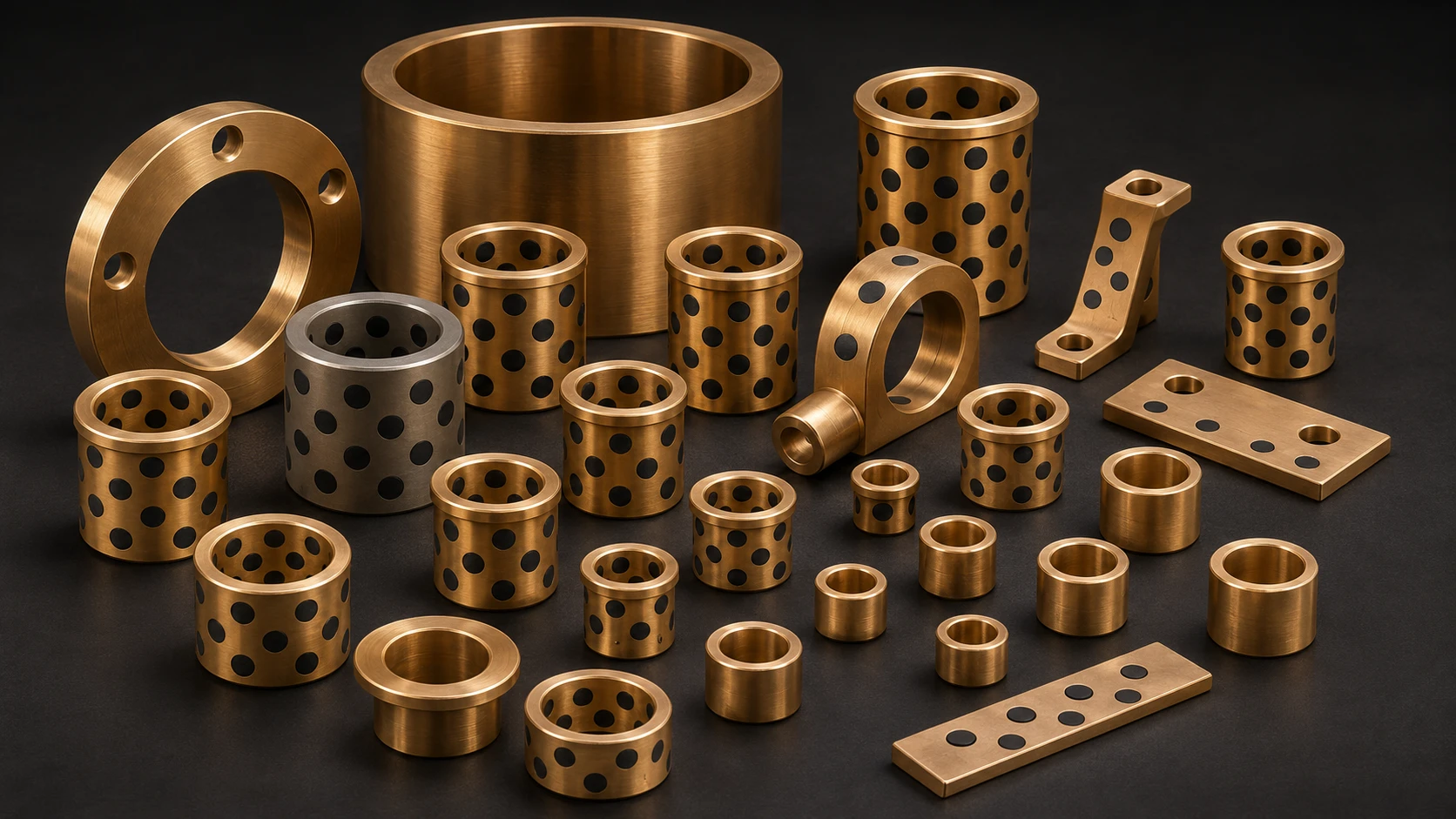
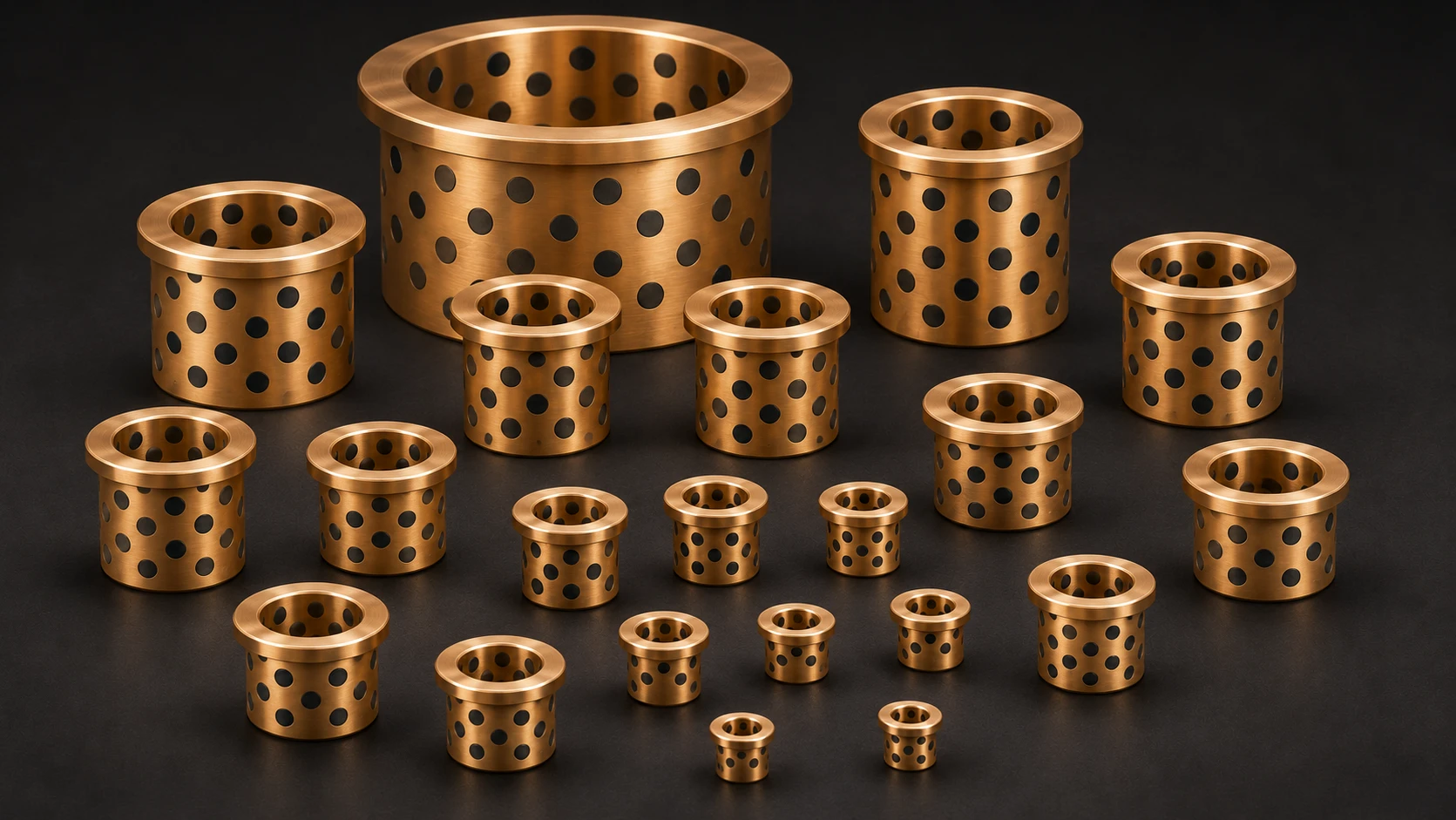
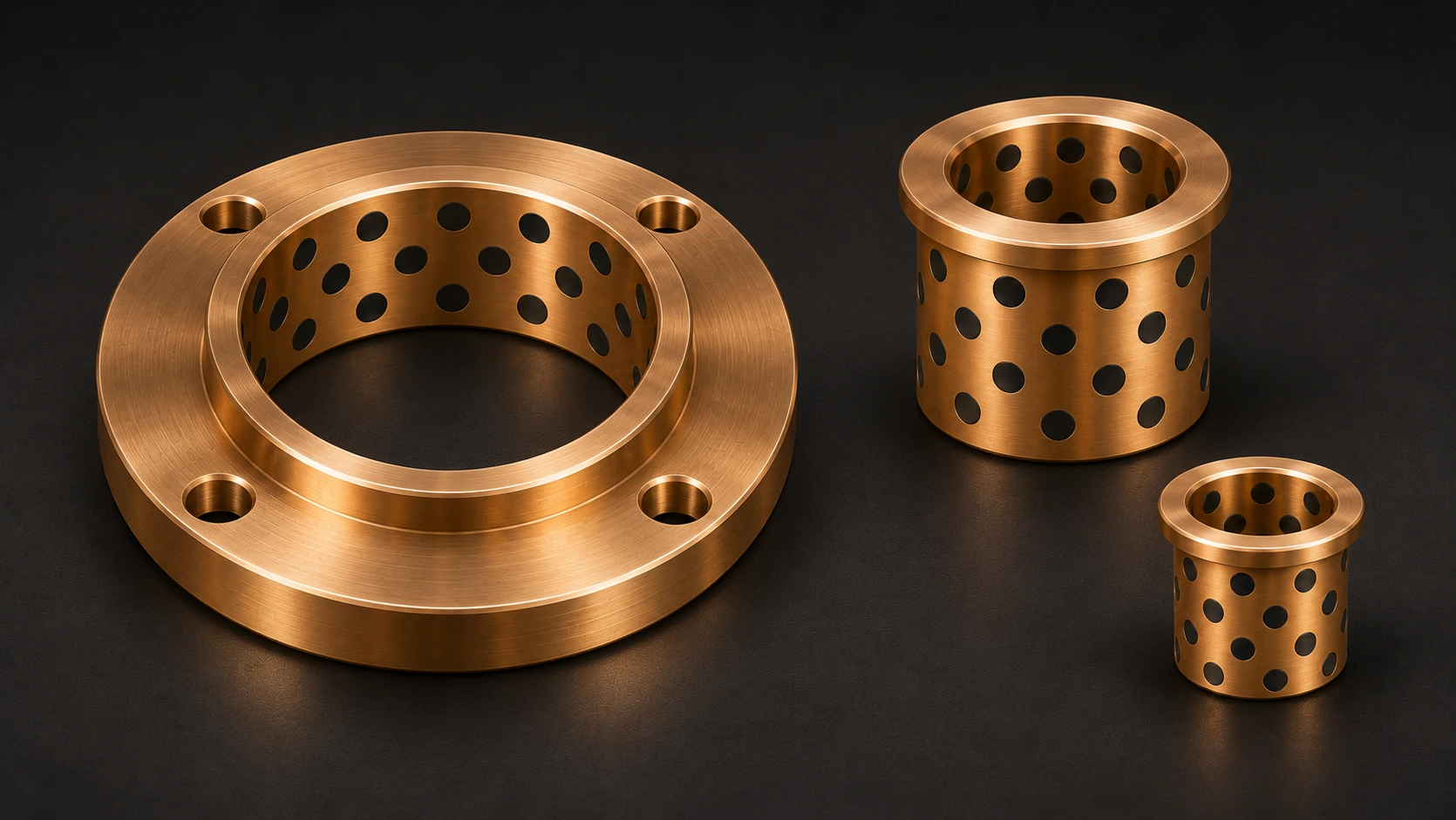
Graphite-plugged bronze components in a wide range of sizes. Wear plates are one part of the range; the same bronze and graphite grades are used for bushes and flanged bushes.
Choose the right type
| Type | Choose this when | Points to note |
|---|---|---|
| Aluminium bronze with graphite plugs (ASTM B505 C95900) | Heavy loads, slow sliding, dies and press slides | Very hard; run it against a hardened, smooth mating surface with lubrication |
| Tin bronze with graphite plugs (ASTM B505 C90500, equivalent to CuSn10) | Medium loads, machine slides, guides, jigs and fixtures | Tougher and easier to machine; a good all-round choice |
| Leaded tin bronze (ASTM B505 C93800) | Sliding guides where graphite plugs are not needed | Lead helps the surface bed in with the mating part |
| Steel with graphite plugs | Very heavy dies, fixtures and mill equipment | Stiffer and harder backing; heavier to handle |
| Wear strip | Plain bar with no mounting holes; you machine or fit it in place | Good when the customer prepares the mounting |
| Wear plate | Cut to size and drilled for bolts, ready to fit | Fastest route to fitting; check the hole pattern against your drawing |
Technical data
Material properties
Figures are supplier minimums or typical values. They are for comparing grades, not for final design. Confirm against the material certificate for your order.
| Property | Aluminium bronze C95900 | Tin bronze C90500 (CuSn10) | Leaded tin bronze C93800 |
|---|---|---|---|
| Typical composition | Copper with aluminium, iron and nickel | 9–11% tin, 1–3% zinc, max 1% lead | 6–7.5% tin, 13–16% lead |
| Minimum hardness | About 241 HB (Brinell) | At least 80 HBW (CuSn10, cast) | Softer; chosen for embedability |
| Minimum tensile strength | Supplier to confirm | 280 N/mm² (≈ 280 MPa) for CuSn10 | About 172 MPa (25 ksi) |
| Minimum yield / proof strength | Supplier to confirm | 170 N/mm² (≈ 170 MPa) | About 110 MPa (16 ksi) |
| Density | Supplier to confirm | About 8.7 g/cm³ | About 9.2 g/cm³ |
| Solidus (start of melting) | Supplier to confirm | Supplier to confirm | About 854 °C (1570 °F) |
| Best mating surface | Hardened steel, ground and polished | Hardened or hard-chromed steel | Steel, any finish that is smooth |
Unit conversions used on this page: 1 MPa = 1 N/mm²; 1 ksi = 6.895 MPa; 1 lb/in³ = 27.68 g/cm³.
Graphite plug coverage
- Plugs are spread evenly over the sliding face in a staggered pattern. Typical coverage is 25–30% of the area. Heavier duty work can use up to about 40%.
- More plugs give more dry lubrication but leave less bronze to carry the load. Pick coverage for how often the plate is oiled.

Cross-section and how the plate works
The plate sits on a steel base. The moving slide rides on the bronze face, and the graphite plugs release a thin film of lubricant as the slide passes over them.

Check your load and speed
Two simple checks tell you whether a plate is likely to suit the job. Send us the results with your enquiry.
1. Bearing pressure
Contact area = Plate length × Plate width (the part of the plate under the slide)
Example: a ram carries 5,000 N on a plate 200 mm long and 60 mm wide.
Pressure = 5,000 ÷ 12,000 = 0.42 MPa
Compare the result with the allowable pressure your supplier gives for the grade. Keep a safety margin, and check the pressure again if the load is shock or impact loading.
2. Sliding speed
Example: a 100 mm stroke at 30 strokes per minute gives 2 × 0.1 × 30 ÷ 60 = 0.1 m/s. Slow, heavy sliding suits aluminium bronze. Faster sliding often suits tin bronze with good lubrication.
Where they are used

- Press and stamping dies, including automotive stamping dies
- Die fixtures, jigs and clamping slides
- Injection moulding machine slides and ejector guides
- Machine tool slides and guideways
- Steel mill and rolling mill equipment
- Cement, mining and crushing machinery
Sizes and standard families
Wear plates are made to recognised families, in metric or imperial sizes. Tell us which family your machine uses, or send the drawing if it is a custom size.
| Family | What it covers | Typical customer |
|---|---|---|
| NAAMS (W01, W02, W03, W05–W07) | Wear plates in imperial and metric sizes, widely used on automotive dies | Stamping die builders |
| VDI 3357 | European wear plate sizes, close to the NAAMS W05–W07 range | European-standard tooling |
| JIS | Japanese series with a broad size range, including small sizes | Japanese-standard machinery |
| Custom | Any length, width and thickness, with your own hole pattern | Special machines and spares |
Fitting the wear plate

- Clean the steel base and the back of the plate. Remove burrs and chips.
- Check the plate against the drawing: length, width, thickness and hole pattern.
- Place the plate on the base and mark or check the hole positions.
- Fix with counter-sunk bolts through the mounting holes. Tighten evenly, so the plate sits flat with no gaps.
- Check that the bolt heads sit below the sliding face. Raised heads score the mating part.
- Apply a light coat of 20 wt oil to the sliding face before the first run.
- Run the machine slowly for a few strokes, check the contact, then bring it up to speed.
Maintenance and troubleshooting
| What you see | Likely cause | What to do |
|---|---|---|
| Stick-slip or jerky movement | Dry face, too little oil, or plugs covered with dirt | Clean the face, re-oil, and check the plug surface |
| Fast wear on one side | Misalignment, or the slide runs off-centre | Check the slide alignment and the bolt torque |
| Squeal or noise | Low lubrication, or the mating surface is too rough | Re-oil; polish or harden the mating surface |
| Cracks or chips at the edge | Impact, levering, or a plate that is too thin for the load | Replace the plate; check the handling and the load check above |
| Bolt heads standing proud | Wrong counter-sink, or bolts too long | Refit with correct bolts so the heads sit below the face |
| Plate worn through | End of service life for the load and speed | Replace the plate; a thicker grade or more plug coverage may help next time |
Frequently asked questions
Can I use a wear plate with grease instead of oil?
Yes. The graphite plugs work with grease as well as oil. Use a grease that suits the bronze and the speed; ask us if you are not sure.
How long does a wear plate last?
It depends on load, speed, lubrication and cleanliness. Plates on dies usually run until the face is worn to the limit set for the machine. Check the face at planned maintenance and keep a spare set.
Which grade should I use for a heavy press slide?
Aluminium bronze suits high loads and slow sliding, run against a hardened, smooth surface. Send the load, speed and stroke and we will confirm.
Do you make wear plates to my drawing?
Yes. Send the drawing or a sketch with the sizes and hole pattern. We will quote the grade, the size and the lead time.
Can I weld a wear plate?
Do not weld bronze to the base in place. Fix plates with bolts through the holes, as described above.
How to order
- Send us the drawing or the standard family and the size.
- Tell us the load, speed, stroke, mating material and lubrication.
- We reply with the recommended grade, the size and the lead time.
- Order, and we deliver the plates ready to fit.
The values on this page are typical or supplier figures for comparison. Final design, grade and size must be confirmed with Sudarsan against your drawing and the applicable standard.